
Transformers documentation
GLPN
This model was published in HF papers on 2022-01-19 and contributed to Hugging Face Transformers on 2022-03-22.
GLPN
This is a recently introduced model so the API hasn’t been tested extensively. There may be some bugs or slight breaking changes to fix it in the future. If you see something strange, file a Github Issue.
Overview
The GLPN model was proposed in Global-Local Path Networks for Monocular Depth Estimation with Vertical CutDepth by Doyeon Kim, Woonghyun Ga, Pyungwhan Ahn, Donggyu Joo, Sehwan Chun, Junmo Kim. GLPN combines SegFormer’s hierarchical mix-Transformer with a lightweight decoder for monocular depth estimation. The proposed decoder shows better performance than the previously proposed decoders, with considerably less computational complexity.
The abstract from the paper is the following:
Depth estimation from a single image is an important task that can be applied to various fields in computer vision, and has grown rapidly with the development of convolutional neural networks. In this paper, we propose a novel structure and training strategy for monocular depth estimation to further improve the prediction accuracy of the network. We deploy a hierarchical transformer encoder to capture and convey the global context, and design a lightweight yet powerful decoder to generate an estimated depth map while considering local connectivity. By constructing connected paths between multi-scale local features and the global decoding stream with our proposed selective feature fusion module, the network can integrate both representations and recover fine details. In addition, the proposed decoder shows better performance than the previously proposed decoders, with considerably less computational complexity. Furthermore, we improve the depth-specific augmentation method by utilizing an important observation in depth estimation to enhance the model. Our network achieves state-of-the-art performance over the challenging depth dataset NYU Depth V2. Extensive experiments have been conducted to validate and show the effectiveness of the proposed approach. Finally, our model shows better generalisation ability and robustness than other comparative models.
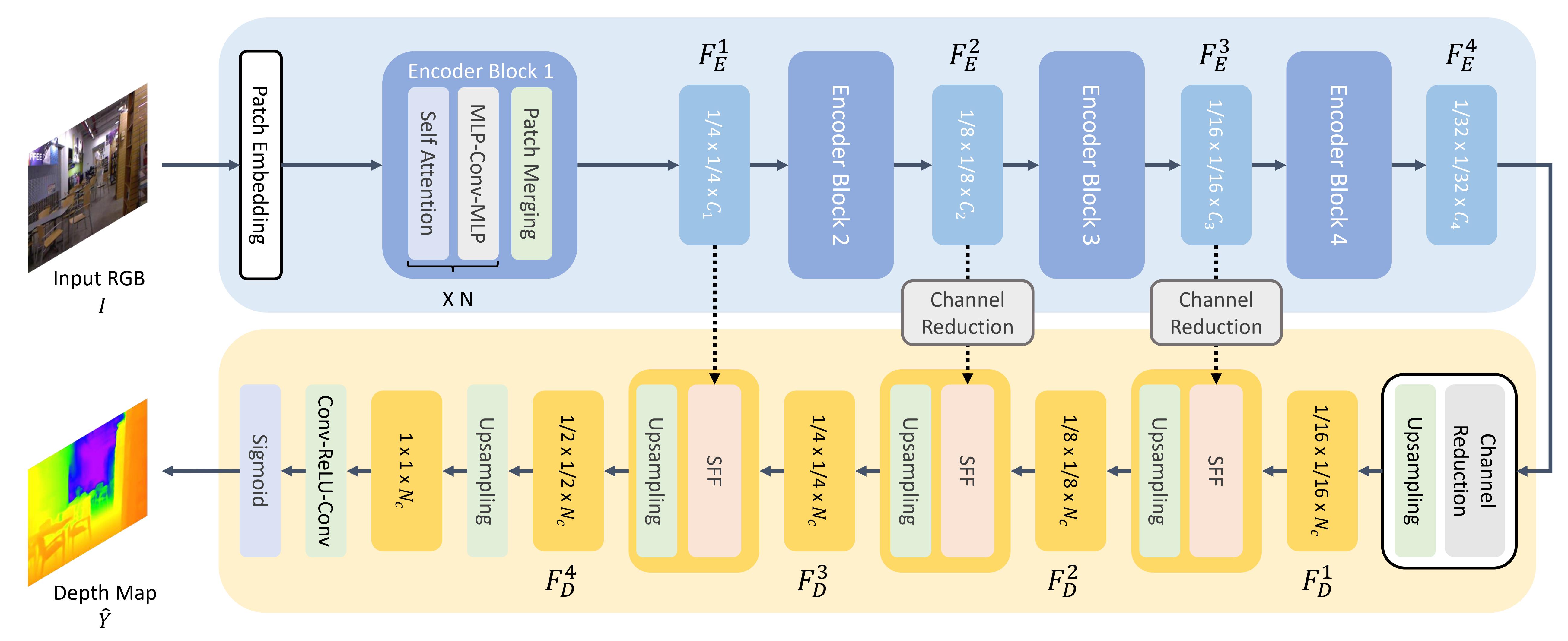 Summary of the approach. Taken from the original paper.
 This model was contributed by nielsr. The original code can be found here.
Resources
A list of official Hugging Face and community (indicated by 🌎) resources to help you get started with GLPN.
- Demo notebooks for GLPNForDepthEstimation can be found here.
- Monocular depth estimation task guide
GLPNConfig
class transformers.GLPNConfig
< source >( transformers_version: str | None = Nonearchitectures: list[str] | None = Noneoutput_hidden_states: bool | None = Falsereturn_dict: bool | None = Truedtype: str | torch.dtype | None = Nonechunk_size_feed_forward: int = 0is_encoder_decoder: bool = Falseid2label: dict[int, str] | dict[str, str] | None = Nonelabel2id: dict[str, int] | dict[str, str] | None = Noneproblem_type: Literal['regression', 'single_label_classification', 'multi_label_classification'] | None = Nonenum_channels: int = 3num_encoder_blocks: int = 4depths: list[int] | tuple[int, ...] = (2, 2, 2, 2)sr_ratios: list[int] | tuple[int, ...] = (8, 4, 2, 1)hidden_sizes: list[int] | tuple[int, ...] = (32, 64, 160, 256)patch_sizes: list[int] | tuple[int, ...] = (7, 3, 3, 3)strides: list[int] | tuple[int, ...] = (4, 2, 2, 2)num_attention_heads: list[int] | tuple[int, ...] = (1, 2, 5, 8)mlp_ratios: list[int] | tuple[int, ...] = (4, 4, 4, 4)hidden_act: str = 'gelu'hidden_dropout_prob: float | int = 0.0attention_probs_dropout_prob: float | int = 0.0initializer_range: float = 0.02drop_path_rate: float | int = 0.1layer_norm_eps: float = 1e-06decoder_hidden_size: int = 64max_depth: int = 10head_in_index: int = -1 )
Parameters
- num_channels (
int, optional, defaults to3) — The number of input channels. - num_encoder_blocks (
int, optional, defaults to 4) — The number of encoder blocks (i.e. stages in the Mix Transformer encoder). - depths (
list[int], optional, defaults to[2, 2, 2, 2]) — The number of layers in each encoder block. - sr_ratios (
list[int], optional, defaults to[8, 4, 2, 1]) — Sequence reduction ratios in each encoder block. - hidden_sizes (
Union[list[int], tuple[int, ...]], optional, defaults to(32, 64, 160, 256)) — Dimensionality (hidden size) at each stage of the model. - patch_sizes (
list[int], optional, defaults to[7, 3, 3, 3]) — Patch size before each encoder block. - strides (
list[int], optional, defaults to[4, 2, 2, 2]) — Stride before each encoder block. - num_attention_heads (
list[int], optional, defaults to[1, 2, 5, 8]) — Number of attention heads for each attention layer in each block of the Transformer encoder. - mlp_ratios (
list[int], optional, defaults to[4, 4, 4, 4]) — Ratio of the size of the hidden layer compared to the size of the input layer of the Mix FFNs in the encoder blocks. - hidden_act (
str, optional, defaults togelu) — The non-linear activation function (function or string) in the decoder. For example,"gelu","relu","silu", etc. - hidden_dropout_prob (
Union[float, int], optional, defaults to0.0) — The dropout probability for all fully connected layers in the embeddings, encoder, and pooler. - attention_probs_dropout_prob (
Union[float, int], optional, defaults to0.0) — The dropout ratio for the attention probabilities. - initializer_range (
float, optional, defaults to0.02) — The standard deviation of the truncated_normal_initializer for initializing all weight matrices. - drop_path_rate (
Union[float, int], optional, defaults to0.1) — Drop path rate for the patch fusion. - layer_norm_eps (
float, optional, defaults to1e-06) — The epsilon used by the layer normalization layers. - decoder_hidden_size (
int, optional, defaults to 64) — The dimension of the decoder. - max_depth (
int, optional, defaults to 10) — The maximum depth of the decoder. - head_in_index (
int, optional, defaults to -1) — The index of the features to use in the head.
This is the configuration class to store the configuration of a GLPNModel. It is used to instantiate a Glpn model according to the specified arguments, defining the model architecture. Instantiating a configuration with the defaults will yield a similar configuration to that of the vinvino02/glpn-kitti
Configuration objects inherit from PreTrainedConfig and can be used to control the model outputs. Read the documentation from PreTrainedConfig for more information.
Example:
>>> from transformers import GLPNModel, GLPNConfig

>>> # Initializing a GLPN vinvino02/glpn-kitti style configuration
>>> configuration = GLPNConfig()

>>> # Initializing a model from the vinvino02/glpn-kitti style configuration
>>> model = GLPNModel(configuration)

>>> # Accessing the model configuration
>>> configuration = model.config
GLPNImageProcessor
class transformers.GLPNImageProcessor
< source >( **kwargs: *<class 'transformers.models.glpn.image_processing_glpn.GLPNImageProcessorKwargs'> )
Parameters
- do_convert_rgb (
bool, kwargs, optional) — Whether to convert the image to RGB. - do_resize (
bool, kwargs, optional, defaults toTrue) — Whether to resize the image. - size (
Annotated[int | list[int] | tuple[int, ...] | dict[str, int] | None, None], kwargs) — Describes the maximum input dimensions to the model. - default_to_square (
bool, kwargs, optional, defaults toTrue) — Whether to default to a square image when resizing, if size is an int. - crop_size (
Annotated[int | list[int] | tuple[int, ...] | dict[str, int] | None, None], kwargs) — Size of the output image after applyingcenter_crop. - resample (
Annotated[Union[int, PILImageResampling, NoneType], None], kwargs, defaults to2) — Resampling filter to use if resizing the image. This can be one of the enumPILImageResampling. Only has an effect ifdo_resizeis set toTrue. - do_rescale (
bool, kwargs, optional, defaults toTrue) — Whether to rescale the image. - rescale_factor (
float, kwargs, optional, defaults to0.00392156862745098) — Rescale factor to rescale the image by ifdo_rescaleis set toTrue. - do_normalize (
bool, kwargs, optional) — Whether to normalize the image. - image_mean (
Union[float, list[float], tuple[float, ...]], kwargs, optional) — Image mean to use for normalization. Only has an effect ifdo_normalizeis set toTrue. - image_std (
Union[float, list[float], tuple[float, ...]], kwargs, optional) — Image standard deviation to use for normalization. Only has an effect ifdo_normalizeis set toTrue. - do_pad (
bool, kwargs, optional) — Whether to pad the image. Padding is done either to the largest size in the batch or to a fixed square size per image. The exact padding strategy depends on the model. - pad_size (
Annotated[int | list[int] | tuple[int, ...] | dict[str, int] | None, None], kwargs) — The size in{"height": int, "width" int}to pad the images to. Must be larger than any image size provided for preprocessing. Ifpad_sizeis not provided, images will be padded to the largest height and width in the batch. Applied only whendo_pad=True. - do_center_crop (
bool, kwargs, optional) — Whether to center crop the image. - data_format (
Union[str, ~image_utils.ChannelDimension], kwargs, optional) — OnlyChannelDimension.FIRSTis supported. Added for compatibility with slow processors. - input_data_format (
Union[str, ~image_utils.ChannelDimension], kwargs, optional) — The channel dimension format for the input image. If unset, the channel dimension format is inferred from the input image. Can be one of:"channels_first"orChannelDimension.FIRST: image in (num_channels, height, width) format."channels_last"orChannelDimension.LAST: image in (height, width, num_channels) format."none"orChannelDimension.NONE: image in (height, width) format.
- device (
Annotated[Union[str, torch.device, NoneType], None], kwargs) — The device to process the videos on. If unset, the device is inferred from the input videos. - return_tensors (
Annotated[str | ~utils.generic.TensorType | None, None], kwargs) — Returns stacked tensors if set to'pt', otherwise returns a list of tensors. - disable_grouping (
bool, kwargs, optional) — Whether to disable grouping of images by size to process them individually and not in batches. If None, will be set to True if the images are on CPU, and False otherwise. This choice is based on empirical observations, as detailed here: https://github.com/huggingface/transformers/pull/38157 - image_seq_length (
int, kwargs, optional) — The number of image tokens to be used for each image in the input. Added for backward compatibility but this should be set as a processor attribute in future models. - size_divisor (
int, kwargs, optional, defaults to 32) — Whendo_resizeisTrue, images are resized so their height and width are rounded down to the closest multiple ofsize_divisor.
Constructs a GLPNImageProcessor image processor.
preprocess
< source >( images: typing.Union[ForwardRef('PIL.Image.Image'), numpy.ndarray, ForwardRef('torch.Tensor'), list['PIL.Image.Image'], list[numpy.ndarray], list['torch.Tensor']]**kwargs: *<class 'transformers.models.glpn.image_processing_glpn.GLPNImageProcessorKwargs'> ) → ~image_processing_base.BatchFeature
Parameters
- images (
Union[PIL.Image.Image, numpy.ndarray, torch.Tensor, list[PIL.Image.Image], list[numpy.ndarray], list[torch.Tensor]]) — Image to preprocess. Expects a single or batch of images with pixel values ranging from 0 to 255. If passing in images with pixel values between 0 and 1, setdo_rescale=False. - do_convert_rgb (
bool, kwargs, optional) — Whether to convert the image to RGB. - do_resize (
bool, kwargs, optional) — Whether to resize the image. - size (
Annotated[int | list[int] | tuple[int, ...] | dict[str, int] | None, None], kwargs) — Describes the maximum input dimensions to the model. - default_to_square (
bool, kwargs, optional) — Whether to default to a square image when resizing, if size is an int. - crop_size (
Annotated[int | list[int] | tuple[int, ...] | dict[str, int] | None, None], kwargs) — Size of the output image after applyingcenter_crop. - resample (
Annotated[Union[int, PILImageResampling, NoneType], None], kwargs) — Resampling filter to use if resizing the image. This can be one of the enumPILImageResampling. Only has an effect ifdo_resizeis set toTrue. - do_rescale (
bool, kwargs, optional) — Whether to rescale the image. - rescale_factor (
float, kwargs, optional) — Rescale factor to rescale the image by ifdo_rescaleis set toTrue. - do_normalize (
bool, kwargs, optional) — Whether to normalize the image. - image_mean (
Union[float, list[float], tuple[float, ...]], kwargs, optional) — Image mean to use for normalization. Only has an effect ifdo_normalizeis set toTrue. - image_std (
Union[float, list[float], tuple[float, ...]], kwargs, optional) — Image standard deviation to use for normalization. Only has an effect ifdo_normalizeis set toTrue. - do_pad (
bool, kwargs, optional) — Whether to pad the image. Padding is done either to the largest size in the batch or to a fixed square size per image. The exact padding strategy depends on the model. - pad_size (
Annotated[int | list[int] | tuple[int, ...] | dict[str, int] | None, None], kwargs) — The size in{"height": int, "width" int}to pad the images to. Must be larger than any image size provided for preprocessing. Ifpad_sizeis not provided, images will be padded to the largest height and width in the batch. Applied only whendo_pad=True. - do_center_crop (
bool, kwargs, optional) — Whether to center crop the image. - data_format (
Union[str, ~image_utils.ChannelDimension], kwargs, optional) — OnlyChannelDimension.FIRSTis supported. Added for compatibility with slow processors. - input_data_format (
Union[str, ~image_utils.ChannelDimension], kwargs, optional) — The channel dimension format for the input image. If unset, the channel dimension format is inferred from the input image. Can be one of:"channels_first"orChannelDimension.FIRST: image in (num_channels, height, width) format."channels_last"orChannelDimension.LAST: image in (height, width, num_channels) format."none"orChannelDimension.NONE: image in (height, width) format.
- device (
Annotated[Union[str, torch.device, NoneType], None], kwargs) — The device to process the videos on. If unset, the device is inferred from the input videos. - return_tensors (
Annotated[str | ~utils.generic.TensorType | None, None], kwargs) — Returns stacked tensors if set to'pt', otherwise returns a list of tensors. - disable_grouping (
bool, kwargs, optional) — Whether to disable grouping of images by size to process them individually and not in batches. If None, will be set to True if the images are on CPU, and False otherwise. This choice is based on empirical observations, as detailed here: https://github.com/huggingface/transformers/pull/38157 - image_seq_length (
int, kwargs, optional) — The number of image tokens to be used for each image in the input. Added for backward compatibility but this should be set as a processor attribute in future models. - size_divisor (
int, kwargs, optional, defaults to 32) — Whendo_resizeisTrue, images are resized so their height and width are rounded down to the closest multiple ofsize_divisor.
Returns
~image_processing_base.BatchFeature
- data (
dict) — Dictionary of lists/arrays/tensors returned by the call method (‘pixel_values’, etc.). - tensor_type (
Union[None, str, TensorType], optional) — You can give a tensor_type here to convert the lists of integers in PyTorch/Numpy Tensors at initialization.
GLPNImageProcessorPil
class transformers.GLPNImageProcessorPil
< source >( **kwargs: *<class 'transformers.models.glpn.image_processing_pil_glpn.GLPNImageProcessorKwargs'> )
Parameters
- do_convert_rgb (
bool, kwargs, optional) — Whether to convert the image to RGB. - do_resize (
bool, kwargs, optional, defaults toTrue) — Whether to resize the image. - size (
Annotated[int | list[int] | tuple[int, ...] | dict[str, int] | None, None], kwargs) — Describes the maximum input dimensions to the model. - default_to_square (
bool, kwargs, optional, defaults toTrue) — Whether to default to a square image when resizing, if size is an int. - crop_size (
Annotated[int | list[int] | tuple[int, ...] | dict[str, int] | None, None], kwargs) — Size of the output image after applyingcenter_crop. - resample (
Annotated[Union[int, PILImageResampling, NoneType], None], kwargs, defaults to2) — Resampling filter to use if resizing the image. This can be one of the enumPILImageResampling. Only has an effect ifdo_resizeis set toTrue. - do_rescale (
bool, kwargs, optional, defaults toTrue) — Whether to rescale the image. - rescale_factor (
float, kwargs, optional, defaults to0.00392156862745098) — Rescale factor to rescale the image by ifdo_rescaleis set toTrue. - do_normalize (
bool, kwargs, optional) — Whether to normalize the image. - image_mean (
Union[float, list[float], tuple[float, ...]], kwargs, optional) — Image mean to use for normalization. Only has an effect ifdo_normalizeis set toTrue. - image_std (
Union[float, list[float], tuple[float, ...]], kwargs, optional) — Image standard deviation to use for normalization. Only has an effect ifdo_normalizeis set toTrue. - do_pad (
bool, kwargs, optional) — Whether to pad the image. Padding is done either to the largest size in the batch or to a fixed square size per image. The exact padding strategy depends on the model. - pad_size (
Annotated[int | list[int] | tuple[int, ...] | dict[str, int] | None, None], kwargs) — The size in{"height": int, "width" int}to pad the images to. Must be larger than any image size provided for preprocessing. Ifpad_sizeis not provided, images will be padded to the largest height and width in the batch. Applied only whendo_pad=True. - do_center_crop (
bool, kwargs, optional) — Whether to center crop the image. - data_format (
Union[str, ~image_utils.ChannelDimension], kwargs, optional) — OnlyChannelDimension.FIRSTis supported. Added for compatibility with slow processors. - input_data_format (
Union[str, ~image_utils.ChannelDimension], kwargs, optional) — The channel dimension format for the input image. If unset, the channel dimension format is inferred from the input image. Can be one of:"channels_first"orChannelDimension.FIRST: image in (num_channels, height, width) format."channels_last"orChannelDimension.LAST: image in (height, width, num_channels) format."none"orChannelDimension.NONE: image in (height, width) format.
- device (
Annotated[Union[str, torch.device, NoneType], None], kwargs) — The device to process the videos on. If unset, the device is inferred from the input videos. - return_tensors (
Annotated[str | ~utils.generic.TensorType | None, None], kwargs) — Returns stacked tensors if set to'pt', otherwise returns a list of tensors. - disable_grouping (
bool, kwargs, optional) — Whether to disable grouping of images by size to process them individually and not in batches. If None, will be set to True if the images are on CPU, and False otherwise. This choice is based on empirical observations, as detailed here: https://github.com/huggingface/transformers/pull/38157 - image_seq_length (
int, kwargs, optional) — The number of image tokens to be used for each image in the input. Added for backward compatibility but this should be set as a processor attribute in future models. - size_divisor (
int, kwargs, optional, defaults to 32) — Whendo_resizeisTrue, images are resized so their height and width are rounded down to the closest multiple ofsize_divisor.
Constructs a GLPNImageProcessor image processor.
preprocess
< source >( images: typing.Union[ForwardRef('PIL.Image.Image'), numpy.ndarray, ForwardRef('torch.Tensor'), list['PIL.Image.Image'], list[numpy.ndarray], list['torch.Tensor']]**kwargs: *<class 'transformers.models.glpn.image_processing_pil_glpn.GLPNImageProcessorKwargs'> ) → ~image_processing_base.BatchFeature
Parameters
- images (
Union[PIL.Image.Image, numpy.ndarray, torch.Tensor, list[PIL.Image.Image], list[numpy.ndarray], list[torch.Tensor]]) — Image to preprocess. Expects a single or batch of images with pixel values ranging from 0 to 255. If passing in images with pixel values between 0 and 1, setdo_rescale=False. - do_convert_rgb (
bool, kwargs, optional) — Whether to convert the image to RGB. - do_resize (
bool, kwargs, optional) — Whether to resize the image. - size (
Annotated[int | list[int] | tuple[int, ...] | dict[str, int] | None, None], kwargs) — Describes the maximum input dimensions to the model. - default_to_square (
bool, kwargs, optional) — Whether to default to a square image when resizing, if size is an int. - crop_size (
Annotated[int | list[int] | tuple[int, ...] | dict[str, int] | None, None], kwargs) — Size of the output image after applyingcenter_crop. - resample (
Annotated[Union[int, PILImageResampling, NoneType], None], kwargs) — Resampling filter to use if resizing the image. This can be one of the enumPILImageResampling. Only has an effect ifdo_resizeis set toTrue. - do_rescale (
bool, kwargs, optional) — Whether to rescale the image. - rescale_factor (
float, kwargs, optional) — Rescale factor to rescale the image by ifdo_rescaleis set toTrue. - do_normalize (
bool, kwargs, optional) — Whether to normalize the image. - image_mean (
Union[float, list[float], tuple[float, ...]], kwargs, optional) — Image mean to use for normalization. Only has an effect ifdo_normalizeis set toTrue. - image_std (
Union[float, list[float], tuple[float, ...]], kwargs, optional) — Image standard deviation to use for normalization. Only has an effect ifdo_normalizeis set toTrue. - do_pad (
bool, kwargs, optional) — Whether to pad the image. Padding is done either to the largest size in the batch or to a fixed square size per image. The exact padding strategy depends on the model. - pad_size (
Annotated[int | list[int] | tuple[int, ...] | dict[str, int] | None, None], kwargs) — The size in{"height": int, "width" int}to pad the images to. Must be larger than any image size provided for preprocessing. Ifpad_sizeis not provided, images will be padded to the largest height and width in the batch. Applied only whendo_pad=True. - do_center_crop (
bool, kwargs, optional) — Whether to center crop the image. - data_format (
Union[str, ~image_utils.ChannelDimension], kwargs, optional) — OnlyChannelDimension.FIRSTis supported. Added for compatibility with slow processors. - input_data_format (
Union[str, ~image_utils.ChannelDimension], kwargs, optional) — The channel dimension format for the input image. If unset, the channel dimension format is inferred from the input image. Can be one of:"channels_first"orChannelDimension.FIRST: image in (num_channels, height, width) format."channels_last"orChannelDimension.LAST: image in (height, width, num_channels) format."none"orChannelDimension.NONE: image in (height, width) format.
- device (
Annotated[Union[str, torch.device, NoneType], None], kwargs) — The device to process the videos on. If unset, the device is inferred from the input videos. - return_tensors (
Annotated[str | ~utils.generic.TensorType | None, None], kwargs) — Returns stacked tensors if set to'pt', otherwise returns a list of tensors. - disable_grouping (
bool, kwargs, optional) — Whether to disable grouping of images by size to process them individually and not in batches. If None, will be set to True if the images are on CPU, and False otherwise. This choice is based on empirical observations, as detailed here: https://github.com/huggingface/transformers/pull/38157 - image_seq_length (
int, kwargs, optional) — The number of image tokens to be used for each image in the input. Added for backward compatibility but this should be set as a processor attribute in future models. - size_divisor (
int, kwargs, optional, defaults to 32) — Whendo_resizeisTrue, images are resized so their height and width are rounded down to the closest multiple ofsize_divisor.
Returns
~image_processing_base.BatchFeature
- data (
dict) — Dictionary of lists/arrays/tensors returned by the call method (‘pixel_values’, etc.). - tensor_type (
Union[None, str, TensorType], optional) — You can give a tensor_type here to convert the lists of integers in PyTorch/Numpy Tensors at initialization.
GLPNModel
class transformers.GLPNModel
< source >( config )
Parameters
- config (GLPNModel) — Model configuration class with all the parameters of the model. Initializing with a config file does not load the weights associated with the model, only the configuration. Check out the from_pretrained() method to load the model weights.
The bare Glpn Model outputting raw hidden-states without any specific head on top.
This model inherits from PreTrainedModel. Check the superclass documentation for the generic methods the library implements for all its model (such as downloading or saving, resizing the input embeddings, pruning heads etc.)
This model is also a PyTorch torch.nn.Module subclass. Use it as a regular PyTorch Module and refer to the PyTorch documentation for all matter related to general usage and behavior.
forward
< source >( pixel_values: FloatTensoroutput_attentions: bool | None = Noneoutput_hidden_states: bool | None = Nonereturn_dict: bool | None = None**kwargs ) → BaseModelOutput or tuple(torch.FloatTensor)
Parameters
- pixel_values (
torch.FloatTensorof shape(batch_size, num_channels, image_size, image_size)) — The tensors corresponding to the input images. Pixel values can be obtained using GLPNImageProcessor. See GLPNImageProcessor.call() for details (processor_classuses GLPNImageProcessor for processing images). - output_attentions (
bool, optional) — Whether or not to return the attentions tensors of all attention layers. Seeattentionsunder returned tensors for more detail. - output_hidden_states (
bool, optional) — Whether or not to return the hidden states of all layers. Seehidden_statesunder returned tensors for more detail. - return_dict (
bool, optional) — Whether or not to return a ModelOutput instead of a plain tuple.
Returns
BaseModelOutput or tuple(torch.FloatTensor)
A BaseModelOutput or a tuple of
torch.FloatTensor (if return_dict=False is passed or when config.return_dict=False) comprising various
elements depending on the configuration (GLPNConfig) and inputs.
The GLPNModel forward method, overrides the __call__ special method.
Although the recipe for forward pass needs to be defined within this function, one should call the
Moduleinstance afterwards instead of this since the former takes care of running the pre and post processing steps while the latter silently ignores them.
last_hidden_state (
torch.FloatTensorof shape(batch_size, sequence_length, hidden_size)) — Sequence of hidden-states at the output of the last layer of the model.hidden_states (
tuple(torch.FloatTensor), optional, returned whenoutput_hidden_states=Trueis passed or whenconfig.output_hidden_states=True) — Tuple oftorch.FloatTensor(one for the output of the embeddings, if the model has an embedding layer, + one for the output of each layer) of shape(batch_size, sequence_length, hidden_size).Hidden-states of the model at the output of each layer plus the optional initial embedding outputs.
attentions (
tuple(torch.FloatTensor), optional, returned whenoutput_attentions=Trueis passed or whenconfig.output_attentions=True) — Tuple oftorch.FloatTensor(one for each layer) of shape(batch_size, num_heads, sequence_length, sequence_length).Attentions weights after the attention softmax, used to compute the weighted average in the self-attention heads.
GLPNForDepthEstimation
class transformers.GLPNForDepthEstimation
< source >( config )
Parameters
- config (GLPNForDepthEstimation) — Model configuration class with all the parameters of the model. Initializing with a config file does not load the weights associated with the model, only the configuration. Check out the from_pretrained() method to load the model weights.
GLPN Model transformer with a lightweight depth estimation head on top e.g. for KITTI, NYUv2.
This model inherits from PreTrainedModel. Check the superclass documentation for the generic methods the library implements for all its model (such as downloading or saving, resizing the input embeddings, pruning heads etc.)
This model is also a PyTorch torch.nn.Module subclass. Use it as a regular PyTorch Module and refer to the PyTorch documentation for all matter related to general usage and behavior.
forward
< source >( pixel_values: FloatTensorlabels: typing.Optional[torch.FloatTensor] = Noneoutput_attentions: bool | None = Noneoutput_hidden_states: bool | None = Nonereturn_dict: bool | None = None**kwargs ) → DepthEstimatorOutput or tuple(torch.FloatTensor)
Parameters
- pixel_values (
torch.FloatTensorof shape(batch_size, num_channels, image_size, image_size)) — The tensors corresponding to the input images. Pixel values can be obtained using GLPNImageProcessor. See GLPNImageProcessor.call() for details (processor_classuses GLPNImageProcessor for processing images). - labels (
torch.FloatTensorof shape(batch_size, height, width), optional) — Ground truth depth estimation maps for computing the loss. - output_attentions (
bool, optional) — Whether or not to return the attentions tensors of all attention layers. Seeattentionsunder returned tensors for more detail. - output_hidden_states (
bool, optional) — Whether or not to return the hidden states of all layers. Seehidden_statesunder returned tensors for more detail. - return_dict (
bool, optional) — Whether or not to return a ModelOutput instead of a plain tuple.
Returns
DepthEstimatorOutput or tuple(torch.FloatTensor)
A DepthEstimatorOutput or a tuple of
torch.FloatTensor (if return_dict=False is passed or when config.return_dict=False) comprising various
elements depending on the configuration (GLPNConfig) and inputs.
The GLPNForDepthEstimation forward method, overrides the __call__ special method.
Although the recipe for forward pass needs to be defined within this function, one should call the
Moduleinstance afterwards instead of this since the former takes care of running the pre and post processing steps while the latter silently ignores them.
loss (
torch.FloatTensorof shape(1,), optional, returned whenlabelsis provided) — Classification (or regression if config.num_labels==1) loss.predicted_depth (
torch.FloatTensorof shape(batch_size, height, width)) — Predicted depth for each pixel.hidden_states (
tuple(torch.FloatTensor), optional, returned whenoutput_hidden_states=Trueis passed or whenconfig.output_hidden_states=True) — Tuple oftorch.FloatTensor(one for the output of the embeddings, if the model has an embedding layer, + one for the output of each layer) of shape(batch_size, num_channels, height, width).Hidden-states of the model at the output of each layer plus the optional initial embedding outputs.
attentions (
tuple(torch.FloatTensor), optional, returned whenoutput_attentions=Trueis passed or whenconfig.output_attentions=True) — Tuple oftorch.FloatTensor(one for each layer) of shape(batch_size, num_heads, patch_size, sequence_length).Attentions weights after the attention softmax, used to compute the weighted average in the self-attention heads.
Examples:
>>> from transformers import AutoImageProcessor, GLPNForDepthEstimation
>>> import torch
>>> import numpy as np
>>> from PIL import Image
>>> from huggingface_hub.utils import httpx
>>> from io import BytesIO

>>> url = "http://images.cocodataset.org/val2017/000000039769.jpg"
>>> with httpx.stream("GET", url) as response:
...     image = Image.open(BytesIO(response.read()))

>>> image_processor = AutoImageProcessor.from_pretrained("vinvino02/glpn-kitti")
>>> model = GLPNForDepthEstimation.from_pretrained("vinvino02/glpn-kitti")

>>> # prepare image for the model
>>> inputs = image_processor(images=image, return_tensors="pt")

>>> with torch.no_grad():
...     outputs = model(**inputs)

>>> # interpolate to original size
>>> post_processed_output = image_processor.post_process_depth_estimation(
...     outputs,
...     target_sizes=[(image.height, image.width)],
... )

>>> # visualize the prediction
>>> predicted_depth = post_processed_output[0]["predicted_depth"]
>>> depth = predicted_depth * 255 / predicted_depth.max()
>>> depth = depth.detach().cpu().numpy()
>>> depth = Image.fromarray(depth.astype("uint8"))